

Memoir Writing: Mapping Self Through Memory
Before I begin writing, I remind myself, and anyone following along in their own writing tasks, that memoir writing is about tracing your life through memory, reflection, and voice. My Realities in 1000 Words is a way of listening to myself. I try to make each sentence a marker of a lived moment, each paragraph an entry shaped by emotion and reflection. My method of writing is rooted in noticing what matters, naming what was formerly invisible, and forging connections with my past and with my readers.
As a writing exercise, it teaches me patience to linger over a memory, describe it fully, and explore its meaning. This then becomes a starting point for other projects, such as devotionals, literary essays, or short fiction. As I craft each sentence, I think of it as planting a seed for a short story or a chapter in a collection of wisdom writing.
Batangueña Ako: Identity, Voice, and Language
Your accent, the words you carry, and the rhythms of your speech are markers of identity. Memoir writing encourages you to notice them.
I was born in Batangas, and my Tagalog carries the puntong “ala eh,” a musical inflection that immediately signals origin. The rising intonation of our sentences, expressions like “alapa” (roughly, indeed?), “bengga gay-on” (why is that), “kainaman na” (untranslateable) both as questions or statements belong to a culture embedded in speech. I recall mornings when neighbors shouted greetings across eskinitas (Pasan ka ga? Where are you going or how are you), the aroma of freshly brewed coffee (daan muna’t magkape), and these playful expressions punctuating our conversations. As we live by the Batangas Bay, words like ista (fish) and sigay (shell) and sihi (clam), pukot, panti, sugpo (all manner of catching fish) are not just vocabulary, but part of an inherited way of seeing the world.
As an exercise in description, reflecting on our voice helps anchors our narrative. For example, ask: how does the way we speak shape our story? How do small linguistic details reveal culture, history, and belonging? In the memoir we allow this voice ample space to resonate.
Place and Memory in Personal Narrative
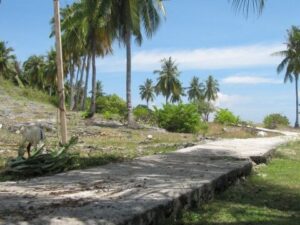
A memoir is anchored in place. Landscapes, homes, and neighborhoods shape identity, memory, and emotional patterns. Malitam, known on the Batangas map as Libjo Aplaya, was my childhood bukid. I remember it as a place with plenty of fruit trees like siniguelas, duhat, camachile, balimbing, and atis. Coconut trees hovered above, forming the first view of the place, while palm groves in shallow marshes surrounded the area. The tail end of the Calumpang River, called Bara, defined its island formation. There was a man-made road guarded by two tall bamboo trees, and as you passed, you would ask permission from the nuno, who might get offended by your careless exit or entry. You would be awed by the swaying bamboo, indifferent to their rare number, simply present in that place, like moving domes.
In the morning, we followed our uncle into the palm marsh as he trapped kungo with bamboo poles. We often climbed the siniguelas tree and pressed our uncle to get our buko, cheering him on as he climbed the steep, resilient coconut tree. In the late afternoon, we peeled camachile until we had collected enough naked seeds to pop into our mouths. And at night, we played tag by the light of the moon, ran around and behind trees, despite the threat of getting knocked over by falling coconut.
Textures in Storytelling
Sometimes, we followed my uncle to the palm groves, where he trapped crabs using bamboo bait. We had one frightening moment when we saw a snake crossing our path. We also had many fun rides with my uncle when he fetched drinking water from the nearby islet, since the wells in Malitam were salty and unfit for drinking. We ran to the beach to swim, then rinsed ourselves at the well.
On the beach, we gathered sigay and poked into sand holes to fetch suso. From there, we could see smoke rising from the huge tubes of the shell refinery and take note of an old ship stranded in the area for a very long time.
We describe our landscapes with sensory detail. As we write, we imagine how the earth smells, learn to listen to the wind, and take note of the island’s distinct shapes, textures, sounds, and colors. Mapping the self through place invites our readers to inhabit our world more fully, creating a richer connection between story and audience.
On Tatay: Absence and Emotional Complexity
Memoir writing encompasses pain, absence, and loss. My father’s presence was defined by absence. Alcoholism shadowed our household, creating insecurity, tension, and emotional pain. This absence continues to reverberate through my intimate relationships. Growing up without a strong male model for love or guidance fostered a kind of naivety that, once exposed, becomes vulnerable to exploitation. As complicated as this pain is, it inevitably contributes to the narrative tension shaping my imagination of love and authority.
As memoir details help readers connect with universal themes of love, disappointment, and growth, grounding our stories in personal truth is crucial.
Inay: Guidance, Influence, and Quiet Strength
If Tatay was absence, Inay was presence, my compass and true north. Her lessons endure; her memory is never tinged with weakness. From morning till night, she seized each moment, wasting no time on idle hobbying or careless loitering. She was patient, diligent, and meticulous. She cooked, she cleaned, she washed our clothes. She sold beauty products and education plans, never for a moment retreating into lazy comfort. When she left us, everything she left behind was useful; nothing was merely decorative. She loved only plants and tended them in neatly lined masiteras in our small apartment unit.
Memoir writing invites me to explore my influences in detail, taking note of the extraordinary in ordinary moments. I think about how small actions, repeated routines, and consistent care has shaped my values and identity. How can I describe them so that readers will feel that lived experience?
Our reflections enrich our memoir as we turn everyday acts into landmarks of the self.
The Body is the Map via the Aging, Health, Routine
Our bodies are repositories of memory. Now in my 60s, health medications, pre-diabetic care, regular medical checkups, and the management required for metabolic regulation interrupt and reshape my daily moments. They have encased themselves into the rituals of aging. On my personal map, this proves that my body archives the wear and tear of experience, illness, and adaptation. Each monitored routine forms part of a story palpable in my muscle, bone, and breath.
Memoir writing invites us me explore these influences in detail, illuminating the body as a narrative base. How do age, health, and physical routines shape my perception of self. I try to describe the sensations, limitations, and adaptations that will give readers a full, embodied experience.
Reflection and Legacy
Time does not end even as my writing reaches its final page. Yet each sentence remains in a continuous present tense, a persistent acknowledgment: I exist. I remember. I matter. But how will my story hold attention? Continuity, presence, and the value of reflection are not merely acts of creation; they are also acts of preservation.
As I document my moments through life writing, wisdom and insight arrive, recede, and return. Continuity, legacy, and the bequeathing of something beyond my intended meaning are therefore not the ultimate goals of my memoir. Rather, my purpose is to gift my life with language, to perform it in code.
Works Cited
Assmann, Aleida. Cultural Memory and Western Civilization: Functions, Media, Archives. Cambridge UP, 2011.
Couser, G. Thomas. Memoir: An Introduction. Oxford UP, 2012.
Damasio, Antonio. The Feeling of What Happens: Body and Emotion in the Making of Consciousness. Harcourt Brace, 1999.
Eakin, Paul John. Living Autobiographically: How We Create Identity in Narrative. Cornell UP, 2008.
Hirsch, Marianne. The Generation of Postmemory: Writing and Visual Culture After the Holocaust. Columbia UP, 2012. Smith, Sidonie, and Julia Watson. Reading Autobiography: A Guide for Interpreting Life Narratives. 2nd ed., U of Minnesota P, 2010.