

“Paglulubid ng buhangin ang pagbibigkis ng ligalig
Sa tunay na buhay, kusang nagbubuhol-buhol ang lubid.”
—Galing na Roon, HUGOS
How Your Language Will Shape Your Life Story
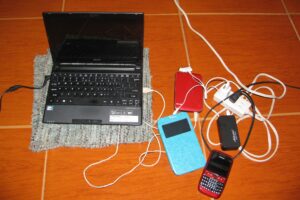
At home, we’ve grown used to saying “load” instead of “data.” My nephew will always say, “Ninan’, please give me load,” when he wants to play Minecraft. I answer as I turn the mobile hotspot on, “No downloading, ha, I have limited data.”
“I need load, Ninan’; I don’t need data.”
Him correcting me on a term that isn’t wrong makes me pause. It wasn’t very long ago that sari-sari stores sold scratch “load cards.” Now, I feel antique insisting on them. Everyone is using GCash. Bills are scanned and paid through QR codes. Coins rarely change hands now. Yet I still say buy load cards, preferring to ‘load’ my phone ‘myself.’
My nephew’s adoption of my term illustrates a core insight from Ludwig Wittgenstein: the meaning of a word comes from use, not from a one-to-one correspondence with things. Words are not mere labels. The meaning of a term, a phrase, or a cultural expression emerges from how it is used within the particular context of a particular life in a particular time. The dictionary may define “salvage” as to save. Yet in Philippine usage, especially during the Marcos dictatorship, “salvage” came to mean the opposite: to annihilate, to summarily execute, to leave a body by the roadside as a warning. Its dictionary equivalent now appropriated in the public memory of an oppressive time.
Beyond One-to-One Correspondence
In my nephew’s digital world, language appears as swiped, tapped, notified, blocked, tagged, hyperlinked. The web-world of language complicates what Ludwig Wittgenstein called the “language game.” Beyond the absence of a one-to-one correspondence between word and thing, meaning of digital codes flexes depending on influencers and the gazillion likes and shares. When something goes viral, its meaning is final.
Antagonistic toward these dynamics, I often turn away from social media. Instead, I return to reliable print. I insist on trusted journalists and seasoned opinion writers from selected periodicals, not academic papers, to affirm, question, or complicate the so-called “political correctness” of language. Increasingly, I fall back on vernacular choices to finalize my intended meanings.
I have been writing in what others call malalim na Tagalog. But I grew up speaking it; in my lived experience, it is not “deep” at all. It is ordinary. It is the language of our home. We spoke it in the market, in church, with relatives and with strangers. Inay reprimanded us in those Tagalog “hala ka” warnings, her harsh tones revealing their deepest endearments.
ANG LANGIT KO
Hindi gaanong napunit ng mga gusali ang langit na
natatanaw mula sa ikalawang palapag nitong bubog
na bintana. Katapat ng panginorin ang natatanging
tinututulan panayam ng higanteng patalastas na
pawatas ng tila pag-unlad. Piniling manatili sa likod
ng babasahin. Panalangin ay makisaya sa kawalang-
gana, makabalik nang may pagtitika sa walang
kapantay na pagtitiyap ng ulap at papel.
—Ang Langit Ko, HUGOS
Memory, Experience, and Subjective Language
If every word is a footprint in time, then how I mean a word to mean springs from my own subjective ground. If I gather people to compare memories, we will not remember shared moments in the same way, even if we walked the same school corridors, passed through the same eskinitas, and joined the same extracurricular clubs. My four siblings and I grew up in the same small apartment unit, yet we diverge sharply in our recollections of family struggles.
How I remember an event lives within me, shaped by the expressions and pressures of my personal context. What rests inside my brother’s or sister’s mind will never be identical to mine. This is an obvious truth about memory.
Yet when I attempt to explore experience through language, I grope for expressions that will be understood in a global sense. Why?
An afterthought: How many authors writing in a regional Philippine language feel compelled to produce an English translation? It seems translation and transcreation is urgent. Our children’s books are bilingual.
Writing the Language of My Lived Experience
The referents of objects evolve: message now, telegram before; email now, letter before; long-distance call then, video call now. In the rituals of birth, child-rearing, courtship, and marriage, expressions shift: lullabies once hummed, now playlists shared; handwritten invitations, now digital RSVPs; church vows once read, now personalized scripts.
In launching a career, the language changes: promotion letters, now performance reviews; office memos, now Slack messages; job applications, now LinkedIn profiles. And almost everything is an app performing a language all its own.
When I turn a story into a poem, short fiction, novella, play, or personal essay, applying what I know from The Elements of Style by William Strunk Jr. and E. B. White is not enough. I must holler the speech of my personal history. I have to situate my language, to embody my generation’s technology, economic conditions, social rules of communication, and political climate.
Because I am not writing for immediate byline gratification but toward reflection, I must allow time and the jargon shaped by its context to persist. I embrace the language of my earlier decades, even when it no longer carries its original register and has lost its contemporary punch.
The Language Game with AI
I am not averse to letting AI assist me with an outline. At times, I even summon an AI agent when I am unsure of structure. But I cannot allow a language produced by AI to skip over time’s tensions, textures, and spectacles. The core language I choose, to preserve the full history of my days, must capture lived nuance. I use “load” instead of “data,” moving away from the generic, unlived truth of my relationship with a thing.
Moving into my seventh decade, it is not always possible to become best friends with the latest, most advanced technology. Yet I give AI my curious attention. To subsume AI into the language game is to prompt it to return to the atmosphere of a specific decade. Buying from a sari-sari store, simply pointing to what I needed, from matches to a kilo of rice in a labo plastic bag, is entirely different from a millennial’s coffee-shop stops with loyalty apps and curated playlists, or a Gen Z’s cashless convenience of QR codes and e-wallet transfers.
The language I choose is witnessing. It recalls my cassette tape hissing as I rewound a song in my Walkman, the static before a long-distance call connected, a party-line listening into my conversations, the phone dial turning crick-ery, crick-ery, crick-ery.
TEXT
Pagal na pagal sa pakikipagbuno
Pag-aapuhap ng mga salita
Magwiwika ba ang buhay?Puting-puti ang pahina
Walang anumang bakas ng pagbubura
Tahimik na tahimik.Walang pagkakaiba sa tinitipid,
Pinapakli-pakling patikim na titik
Na kailangang ipitin sa takdang bilang.—Text HUGOS
Explore your Philippine language in memoir. Subscribe to pageawriter.com .
Enroll in our fellowships and workshops.
Or share your best creative non-fiction to Ninang J at WordHouse.