

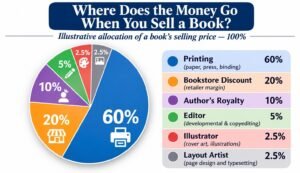
Before sending your manuscript to the printer, understand the costs that go into producing a book.
Congratulations! You have finished your manuscript. Perhaps it is a memoir, literary essays about niche experiences, a novel, a poetry collection, career wisdom and ideas, or devotionals you feel called to share.
The next obvious question is: How much will it cost to print my first book?
But wait—there’s more. Printing is only one part of publishing.
What You Need to Prepare for Your Readers
Before your manuscript becomes a book, there are several things to attend to:
- Reviewing the manuscript
- Editing the language
- Checking the proofs
- Designing the pages and cover
- Planning how the finished copies will reach your readers
These are some of the tasks that come after completing your draft. To answer the question, “How much will it cost me?”, let’s consider a 200-page book with an initial print run of 500 copies.
What Goes into the Publishing Budget?
These estimates are based on a 200-page book and an initial print run of 500 copies. Actual quotations will vary according to trim size, kind of paper, color requirements, binding, and other production specifications.
| Publishing expense | Estimated cost |
| Developmental editing | ₱15,000–₱35,000 |
| Copyediting | ₱10,000–₱20,000 |
| Proofreading | ₱5,000–₱10,000 |
| Interior layout | ₱7,000–₱15,000 |
| Cover design | ₱5,000–₱12,000 |
| ISBN application | No application fee listed by the National Library of the Philippines; registration requirements apply |
| Printing, 500 copies | ₱60,000–₱90,000 |
| Shipping and handling | ₱5,000–₱10,000 |
| Contingency allowance (10%) | ₱10,700–₱19,200 |
The revised preliminary total is approximately ₱117,700 to ₱211,200.
This calculation applies a 10% contingency allowance to the other listed expenses. The figures remain planning estimates and should be updated with actual quotations before you commit to a project.
One important detail about the ISBN: in the Philippines, a first-time individual author applying for an ISBN for their own publication needs to secure NBDB registration under the Author/Writer category. An enterprise applying as a publisher follows the publisher registration route. The ISBN application is then made through the National Library of the Philippines. The National Library also has publication-submission requirements, including legal deposit copies after publication. Check the latest requirements before proceeding.
An ISBN identifies a particular book edition and format; it is not a substitute for copyright protection.
This budget reminds us that the cost of producing a book is not simply the printer’s quotation. Part of your investment goes into editorial preparation and design.
Why Editing Matters
A trusted editor is your first and best friend in publishing.
Editing is not one single task:
- Developmental editing looks at the larger work: its structure, argument, narrative flow, organization, and completeness.
- Copyediting addresses clarity, consistency, grammar, usage, and style.
- Proofreading is the final check for errors after the book has been laid out.
These stages serve different purposes. Skipping them may reduce your initial expenses, but it can also leave problems that are more difficult and costly to correct after printing.
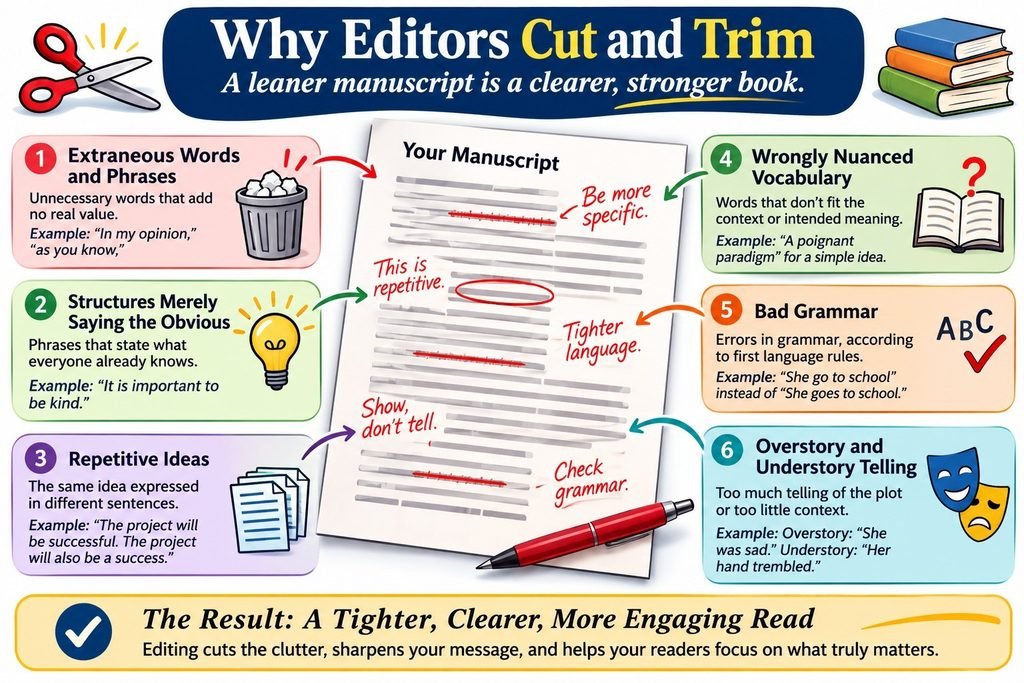
Your manuscript will need an assessment to determine the kind of editorial intervention it requires. Before committing to production expenses, an editor can help you, streamline your organization and structure, trim unnecessary pages and repetition, strengthen your points and develop your ideas. These may sound like simple adjustments, but their effects can be significant. A well-organized manuscript can help reduce production costs while giving you a more coherent presentation of the message you have packaged into those pages.
How Much Should You Sell Your Book For
Authors who choose to self-publish often have an advocacy, a cause, or a particular readership in mind. Others publish to promote a brand, a business, or a specialised area of knowledge. For these authors, selling the book may be an important part of the project.
Using our revised preliminary production budget, the estimated break-even price would be approximately ₱235.40 per copy at the lower budget and ₱422.40 at the higher budget, assuming all 500 copies are sold.
These are simplified estimates. They do not yet account for discounts, retailer or distributor commissions, taxes, marketing, unsold copies, complimentary copies, or other selling expenses. Your actual income from book sales will therefore be lower than the gross sales figure.
It is important to distinguish between recovering production costs and earning a profit. A book may sell well and still fail to recover the full investment if its selling price and distribution arrangements have not been properly planned.
For perspective, here is what the gross sales would look like if all 500 copies were sold:
| Retail price per copy | Gross sales |
| ₱300 | ₱150,000 |
| ₱400 | ₱200,000 |
| ₱500 | ₱250,000 |
At ₱300, the project would not recover the higher estimated production budget. At ₱400, it would exceed the lower estimate but fall short of the higher one. At ₱500, it would exceed both estimates, before accounting for additional selling expenses.
These figures are not a guarantee of profit. They simply help an author understand the relationship between production costs, selling price, and the number of copies that must be sold.

Preparing the Manuscript for Printing and Distribution
What is the first phase of the publishing process?
It begins with an assessment of the manuscript, where an editor identifies its strengths and weaknesses. You may then need to revise the work based on the editor’s recommendations. At this stage, you, the author and your editor should have established a clear understanding of the book’s purpose and intention.
During the second phase, the manuscript undergoes copyediting and proofreading. A layout artist prepares its appearance on the actual recto and verso pages—the right-hand and left-hand pages of the book. An illustrator or designer develops the cover or dust jacket, as appropriate. The author, editor, or publishing liaison also checks the applicable ISBN requirements and other publication requirements.
The next phase is production and distribution. To prepare for this, consider the following checklist:
- Request and compare printer quotations.
- Review and approve a proof before authorising the full print run.
- Consider pre-orders to help estimate demand.
- Plan distribution, promotion, and sales.
Notice that the last item requires its own budget. Preparing a book for printing is one thing; making it available and discoverable to readers is another.
Authors must think beyond who will read the book. How will readers discover it? Where will it be sold? How will you encourage sales and manage the copies that remain unsold?
Different publishing routes will involve different costs and responsibilities. Independent printing, print-on-demand services, eBook publication, and submitting a manuscript to an established publisher for possible co-production each offer a different degree of control to the author.
The choice is not as simple as selecting whichever option appears cheapest.
Before You Ask for a Printing Quotation
Prepare a clear description of your book so that you can compare quotations meaningfully.
- Approximate page count. How many pages will your finished manuscript have?
- Trim size. There are standard book sizes, but you can also consider a different shape or format depending on your design.
- Interior printing. Will the pages be black-and-white or in colour? Will the book contain photographs, images, diagrams, or special illustrations by another artist or by you?
- Paper and cover specifications. Do you prefer glossy or matte finishes, or smooth or textured paper?
- Binding preference. What type of binding is appropriate for your book? The choice will affect both appearance and durability.
- Initial quantity. How many copies would you like printed?
- Manuscript readiness. Has the manuscript been edited and formatted? Reprinting can be costly if errors are discovered after the pages have already been produced as books.
A book is more than a stack of printed pages. It is a work that has been developed, edited, designed, produced, and prepared for readers.
Understanding the full process helps make independent publishing and authorship a faithful stewardship of this important phase of your mission and calling.
Let Page a Writer Weekly usher you into a better understanding of the work, responsibilities, and decisions involved in bringing a manuscript into print.