
Writing Begins with Naming
Writing does not begin with ideas, as I once thought, but with something more grounded, almost physical, a name. A place arrives first as a label before it becomes a landscape on the page. A character comes into view through a cluster of sounds that feel random at first, until they begin to hold together, until they start to feel like a presence. A pebble, a glass on a table, a river, none of these exist in writing until I first pull them into language.
In the early stages of drafting, when everything still feels unsure, I find myself giving names before I fully see what they belong to. I write a person into being through a name I do not yet understand. I place a setting somewhere I only sense in fragments. This is automatic, but never neutral. The moment I name something, it stops being open. It becomes fixed, specific, and answerable. To write at all is to keep doing this: naming, narrowing, choosing, until a world slowly takes shape.
Names as Carriers of History
A name never starts with me. By the time I meet it, it has already been used, repeated, changed. It has passed through other mouths, other spellings, other ways of writing sound into record.
I think of surnames in my own family, where small changes are taken for granted. One branch keeps a spelling steady, while another shifts by a letter or two. A missing letter in a document, a vowel stretched through habit, and the trace of a life starts to tilt. What looks fixed on paper is often uneven underneath.
Place names work in the same way. Roads in Batangas Poblacion still carry older names even when people no longer speak about their origin. Some barangay names live only in the speech of elders, spoken alongside newer official names. At times, I hear a place called one thing on a map and another at a street corner, both versions existing at once, neither fully replacing the other.
When I choose a name in writing, I enter that same instability. Even when I think I am choosing for sound or rhythm, I am also placing it inside histories I do not fully see. A name can flatten that history or let it surface in a small way. It can erase as easily as it remembers. Once written, it no longer stays under my control.
Accuracy as the First Discipline of Imagination
There are moments when my writing slows under the weight of accuracy. I stop mid-line because I am unsure if a name belongs where I placed it. It feels slightly out of place, as if it came from another island, another set of people. I ask myself if it is still used in daily speech or if it only lives in records now. These are small questions, but they change how the sentence moves.
This attention forces me to see the gap between a name that only sounds familiar and one that actually sits inside a living pattern of language. I feel that I am separating something that feels loosely “Filipino” from something shaped by a specific place, with its own mix of migration, religion, and history.
Accuracy, for me, is not only correction, but also a reading. A name can have that Catholic habit, indigenous tradition, inclination to a foreign culture, or a break from all of these. When I name a character, I am not only identifying them in a story, I am also placing them inside overlapping histories they do not fully control.
Naming Beyond Correctness
Accuracy alone is never enough. A name can be correct and still feel empty in the sentence. It can be spelled right and still not belong to the world I am trying to build. At some point, correctness can stop leading the writing. What takes over is more listening. I read names out loud, not to check them, but to feel them. Some names soften the language around them. Others tighten it. Some settle into scenes, as if they were already there. Others remain isolated, as invented. Made-up names gather meaning through sound, repetition, and their place beside other words.
My question becomes, what does this name do here? What does it open, and what does it hide? For a name is never alone. It sits next to other names, shaped by the sound I hear and by what readers expect it to do before they read further.
The Paradox: Fidelity and Invention
If I pause too long to look things up, naming starts to sit outside the writing instead of moving with it. Care turns a story into hesitation. The page fills with possibilities, and the writing loses its forward motion.
Still, I cannot let go of accuracy. Without it, my writing will drift too far from anything I can recognize. The problem is not choosing between truth and invention, but holding both without letting one erase the other.
A fictional barangay, for example, does not need to exist on any official list. But it still needs to feel like it could exist, shaped by patterns of naming that move through the local language. It needs to sound possible without depending on proof.
Invention, for me, is not escape from reality, but giving attention to how reality shifts. Names change in speech. They shorten when spoken fast, stretch when formal, soften with care, harden with distance. Invention in writing is listening closely to these shifts and staying with them for a longer meditative time.
The Limits of Naming
Naming never finishes what it starts. A full name cannot hold a full life. A place name cannot contain everything that has happened there, especially what was never written down. There is always something left out, a memory that never entered records, relationships that never became official, stories that survive only in fragments. Every name points to more than it can hold, moving but never arriving. The more careful I am with naming, the more I see this gap.
What I am left with is a slower way of naming. I try to stay aware that naming cannot hold everything. Before I settle on a name, I ask myself different things. Not only if it fits, but what it assumes. What it borrows without saying. What it makes easy to see, and what it quietly moves out of sight.
Naming becomes less about final choice and more about responsibility. Each name shapes how a world is entered. It decides who feels central and who slips into the background before anything happens. To name is already to interpret.
The Foundation and Limit of Imagination
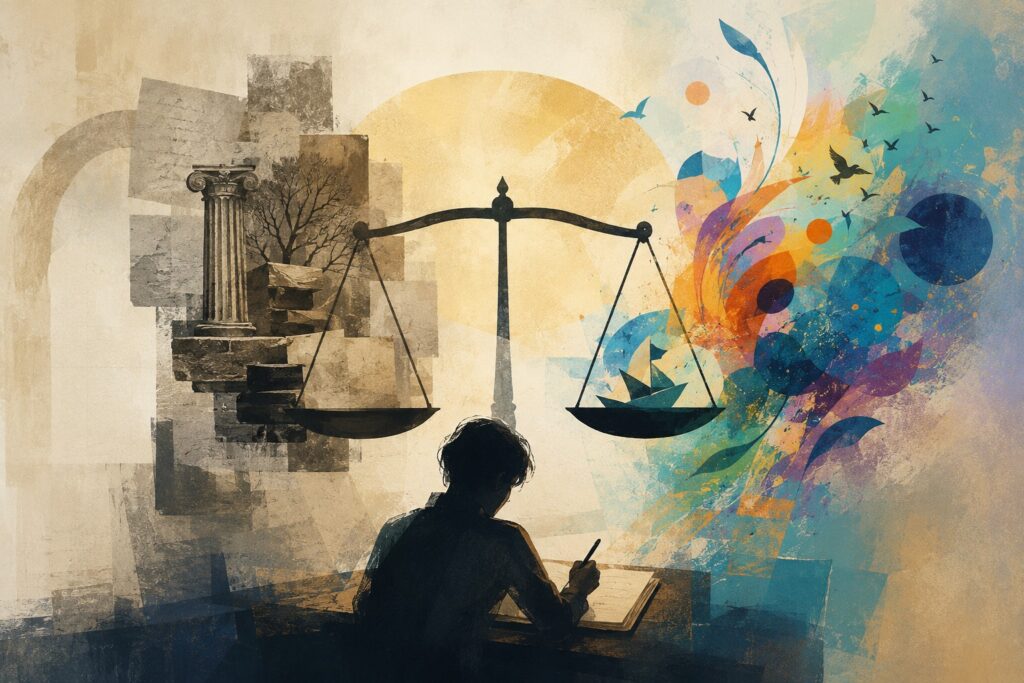
Naming sits at both the start and the edge of writing, making a world possible, while also showing me that this world will never be fully held by words. Naming shapes my imagination, but this shaping is never finished. I keep writing inside the tension between what I can name and what resists naming, between what I know and what I can only reach toward. Imagination stays close to the name, returns to it, and keeps adjusting it each time it settles into something that feels possible.