


A Word Fellow Shop: Conquering the Wide Page
When we are beginning to write, the page before us always looks intimidating. Yet our goal as writers is to conquer this initial shock. In this WordShop, we will:
- Write from a specific lived moment
- Trust fragments as valid narrative units
- Practice withholding and revealing meaning
- Develop a short piece grounded in image, texture, and atmosphere
| 1. Writing that Living Moment | 2. Trusting the Units of meaning | 3. Making Space for the Reader | 4. Holding the Page Captive |
| Moving from general ideas to specific sensory recall | Allowing uncertainty to remain visible in the text | Noting strategic silence and crafting with restraint | Choosing the image, resonating depth |
| Writing the moment without explanation | Writing fragments without forcing coherence | Writing with awareness of the reader’s presence | Describing using the most apt details |
Writing Prompts for Flash Memoir (300–800 words)
A page always feels too wide when we start writing. It is as if we’re reaching beyond the margins of the white, blank, open space, groping for that thing deserving attention.
A draft may begin by prompting an automatic agent to surface fictional events or remembered fragments. From there, true moments emerge, apt images shaped for lived essence and sensual impact. The language begins to resonate when we move beyond mere self-projection.
As we circle a moment, then expand and explain, the experience grounds itself. We arrive at a precise atmosphere or texture, where a word was spoken, or where silence quietly held.
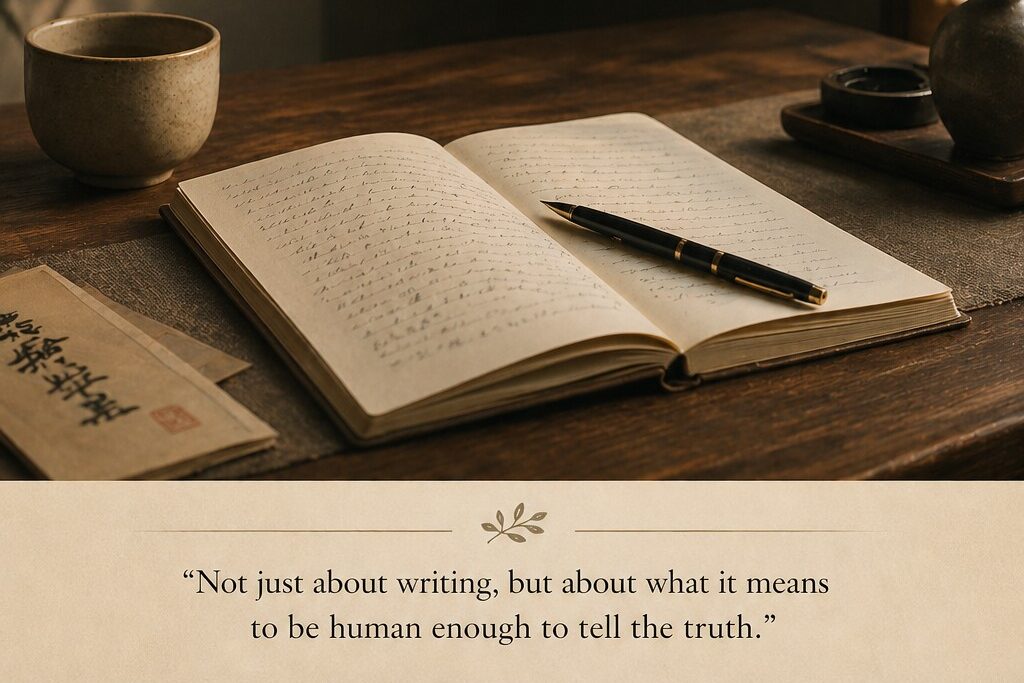
Where the Page Begins to Narrow
On the wide page, everything penned will beg to stay. Any single moment will remain as a question, not easy to answer, demanding no answer, not waiting for an answer, without an answer. The imminent text that will come to life draws closer as the page begins to narrow, and what remains is shaped by a definite choice at this stage of writing: selecting a theme, choosing a point of view, and deciding which moment becomes the center of the narrative.
How Not to Remember Wrongly
Random memories from childhood: I recall walking home with my best friend, kneeling on mongo beans as punishment in grade four, getting low marks in math, best in cursive handwriting, Inay bundling my 100 perfect scores, a bully chanting my name like it’s a curse, my younger sister shouting for her allowance from the main door of the classroom.
Each of these memories is reenactable; each one is a scene I can still render in words, shaped into a final essence. Though the exact details are now blurred and fragmented, writing them for an audience requires plotting and structure, turning memory into narrative.
At this stage, the work becomes more than recall. Composing means choosing the scene that best carries the theme, the point of view that holds the distance, and the fragment arrangement that directs meaning. Nothing is arbitrary; everything is deliberate.
When the Page Is No Longer Too Wide
The page begins to hold the memory of a single moment when we choose that image that will bring the memory back to life.
- Write the moment without explaining its meaning. Describe the scene: Locate yourself. What is happening? What do you hear, what is being said or not said? Avoid interpretation.
- Write a fragment sequence. Choose five or seven fragments from childhood or a specific age. Write them as a continuous piece without transition. Let the arrangement itself create the connection.
- Writing the image that holds the memory Choose one image that returns a memory to life (an object, gesture, or sound). Write the memory through or from that image. Let everything in the piece return to it.
- Write a memory where something important is deliberately left unsaid. Allow pauses, indirect references, vague citations, shifts in tone.
- Write a broad statement, then work it out into a concrete scene of a lived moment.
Making Space for the Reader’s Breath
Sometimes, in imitation of master texts or iconic examples, our page moves slightly off the beat of tradition. We are not less conscious of the reader when we leave something unsaid, or when we insist on saying what is difficult to say, or when we remain vague, abstract, or neutral on certain issues.
Readers will still find something to take away, but first, they must be willing to meet the text halfway, to bring their own experience into what is being read. Meaning is not only delivered; it is also completed by the reader’s recognition.
In this sense, the story on the page takes on a life of its own, shaped not only by what is written, but by what is entered into it through reading.
- In the Dream House – Fragmentary memoir structure, repetition, and the use of form as psychological architecture.
- Bluets – Lyric fragments, associative thinking, and the refusal of linear memoir logic.
- A Field Guide to Getting Lost – Method writing through uncertainty, digression, and reflective wandering.
- The Liars’ Club – Vivid, grounded childhood memory rendered through scene precision and emotional specificity.
- The Art of Memoir – A companion craft text on truth, distortion, and emotional accuracy in memoir writing.
- Tell It Slant – Practical and teachable strategies for lyric essay, fragmentation, and non-linear memory.
- The Chronology of Water – Embodied, disrupted memoir structure where trauma is rendered through non-sequential form.
- Fun Home – Graphic memoir demonstrating how image, scene, and recursion build layered autobiographical truth.
- Dept. of Speculation – Fragment-based narrative that mirrors cognitive and emotional discontinuity in lived experience.